What Is Neuroception? When a Child's Brain Misreads Sensory Information
Sep 24, 2026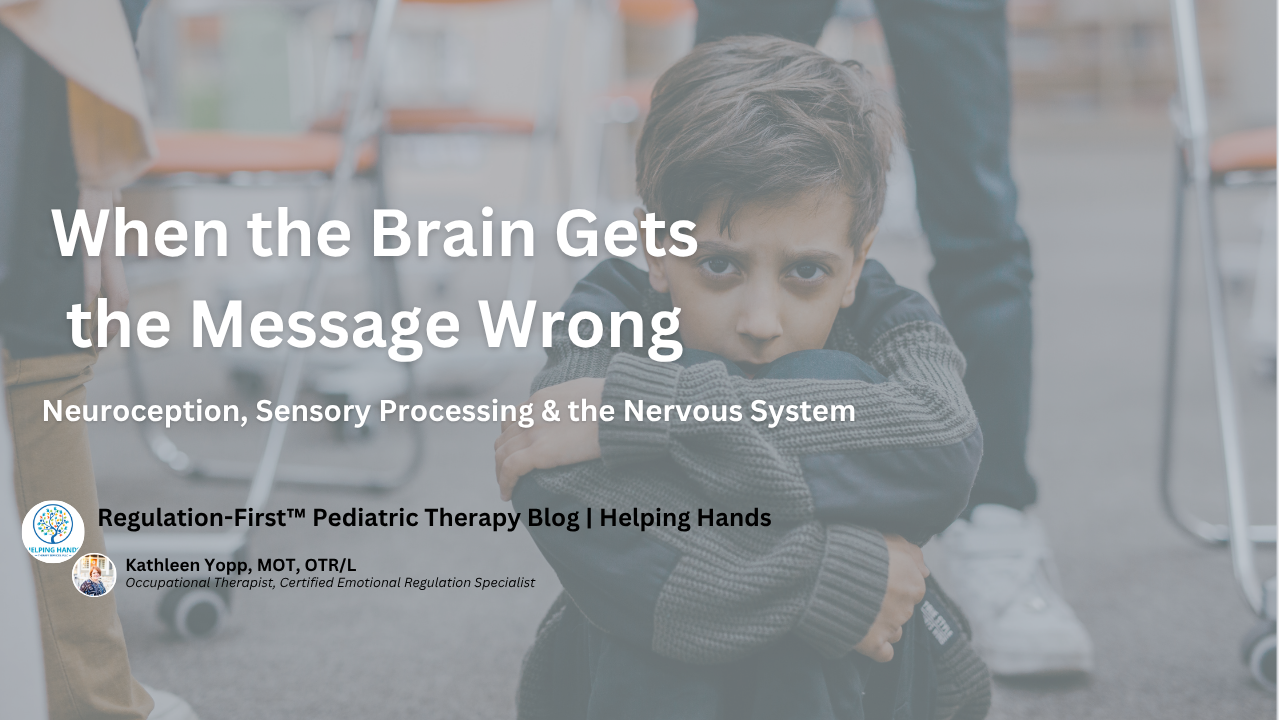
What Is Neuroception? When a Child's Brain Misreads Sensory Information
Have you ever walked into a room and immediately felt like something was off?
No one said anything.
Nothing obvious happened.
But maybe someone's facial expression changed. Their tone sounded different. The room felt unusually loud or chaotic.
Before you consciously figured out what was happening, your body may have already responded.
Your stomach tightened. Your shoulders tensed. Your heart beat a little faster.
Your nervous system was processing information before your thinking brain had put words to it.
Children's nervous systems do this too.
And sometimes, what looks like refusal, anxiety, avoidance, overreaction, or challenging behavior may begin with a nervous system responding to information it has interpreted as potentially threatening.
This is where understanding neuroception in children can change the way we look at behavior.
What Is Neuroception?
The term neuroception comes from Polyvagal Theory. It describes the proposed process through which the nervous system detects cues associated with safety, danger, or threat without requiring conscious awareness.
In simple terms, your thinking brain might be saying:
“I'm safe.”
While your nervous system is responding:
“I'm not so sure.”
Your nervous system is constantly receiving information from the world around you.
It notices facial expressions, voices, movement, sounds, smells, touch, body position, internal sensations, and changes in the environment.
You don't consciously analyze every piece of that information.
But your brain still has to determine:
Does this matter?
Can I ignore it?
Do I need to respond?
And sometimes, that protective system can sound an alarm even when there isn't an actual danger.
When the Nervous System Sounds a False Alarm
I use a smoke-alarm analogy in my children's book The Overwhelm Mother because it makes this complicated concept much easier to understand.
You can download a copy of the book here >> READ NOW
In the story, Kim learns that her body can respond to a stressful situation as though there is danger—even when there isn't an actual threat.
She describes it this way:
“It tries to keep me safe, but sometimes it thinks the Burning toast is a four-alarm fire.”
Think about what a smoke detector is designed to do.
Its job is to protect you.
Sometimes there's a house fire.
Sometimes you burned the toast.
But the alarm can sound in either situation.
Our protective nervous-system responses can sometimes work similarly.
The alarm is real even when the danger isn't.
And that can help us understand some behaviors very differently.
When Sensory Information Feels Like Danger
Our sensory systems constantly provide the brain with information.
But the same sensory input doesn't necessarily have the same meaning for every nervous system.
A sound one child barely notices may feel overwhelming to another.
A light touch that feels affectionate to you may feel startling or uncomfortable to someone else.
A crowded classroom might feel exciting to one child and overwhelming to another.
And previous experiences matter too.
Consider a child who has experienced a painful bowel movement.
The next time they feel pressure signaling the need to poop, their brain isn't necessarily processing that sensation simply as:
I need to use the bathroom.
Their nervous system may have learned:
This sensation came before something hurt.
They may tighten their muscles, hide, avoid the bathroom, or begin withholding.
We can see something similar with feeding.
If eating has repeatedly been associated with gagging, reflux, choking, pain, pressure, or distress, the sight, smell, texture, or expectation of food may trigger a protective response.
The food may be safe while the nervous system's alarm is still saying, “No.”
That doesn't mean every refusal is caused by neuroception. It means the child's nervous-system response is one important piece we may need to consider.
Neuroception vs. Interoception: What's the Difference?
These terms are related, but they aren't interchangeable.
Neuroception describes the proposed unconscious detection of cues associated with safety or threat.
Interoception involves sensing and interpreting what's happening inside your body—things such as heartbeat, hunger, fullness, temperature, muscle tension, breathing, and bowel or bladder sensations.
And this is where things get particularly interesting.
The body may start changing before the child can tell you what's wrong.
In The Overwhelm Mother, Kim doesn't suddenly become overwhelmed.
Her body gives her clues first: her heart beats faster, her shoulders tighten, her stomach feels fluttery, and her jaw clenches.
Learning to notice those early body signals gives her an opportunity to respond before she becomes completely overwhelmed.
Children can learn this too.
What Can This Look Like in Children?
When a child's protective system becomes activated, we may see very different responses.
One child might become loud, argumentative, controlling, aggressive, or highly active.
Another might run away, hide, avoid, refuse, or desperately try to escape the situation.
Another may become quiet, withdrawn, tired, or unable to respond.
Sometimes it looks like:
“I won't eat that.”
“I don't have to poop.”
“Don't touch me.”
“It's too loud.”
“I'm not going.”
Or simply:
“NO!”
The behavior still matters. Boundaries and expectations still matter.
But instead of beginning only with:
“How do I stop this behavior?”
try asking:
“What information might this child's nervous system be responding to?”
That question gives us somewhere different to start.
What Can Parents and Therapists Do?
Understanding what's happening is useful.
But ultimately, we need to know what to do with that information.
I use a simple sequence in my My Calm Body Toolkit:
NOTICE → NAME → SHIFT → SAVOR → REPEAT
The goal isn't to make a child calm all the time.
It's to help children become more aware of their own body states, discover what supports regulation, and practice those skills repeatedly.
1. NOTICE
Before we ask children to regulate their bodies, we can help them learn to recognize what their bodies are telling them.
Instead of immediately saying:
“Calm down.”
we can become curious.
Is your heart beating fast?
Do your hands feel tight?
Does your face feel hot?
Do you feel like running?
Does your body feel heavy?
Is talking difficult right now?
The My Calm Body Toolkit helps children identify these kinds of body clues and where they feel them.
This helps make an invisible internal experience more understandable.
2. NAME
Next, give the experience simple, nonjudgmental language.
In the toolkit, children meet three body states:
Sunny — Calm & Cozy
Zip — Zoomy
Mo — Slow & Heavy
Importantly, none of these states is “bad.”
The child isn't bad.
Their body is experiencing a state.
That distinction matters.
3. SHIFT
Once we've identified the state, we can ask:
What might this particular nervous system need right now?
There isn't one universal calming strategy.
One child may need movement.
Another may respond to proprioceptive input.
Another may need less sensory input, more space, rhythm, humming, connection with a trusted adult, or simply time.
The My Calm Body Toolkit offers choices including wall pushes, humming, rocking, stretching, tapping, breathing activities, and movement.
Instead of asking:
“What makes kids calm?”
ask:
“What helps this child's nervous system become more organized?”
4. SAVOR
This is the step we often forget.
We're very good at noticing dysregulation.
But do we teach children to notice regulation?
When the body feels settled, pause.
What do your muscles feel like?
What does your breathing feel like?
Where do you feel calm in your body?
What helped you get here?
The toolkit intentionally asks children to notice and stay with the experience of feeling calm.
We aren't only teaching children what to do when their alarm sounds.
We're helping them become familiar with what regulation feels like.
Look for Glimmers, Not Just Triggers
We spend a lot of time looking for triggers.
And sometimes we should.
But I also want to know:
What helps this nervous system feel safe, connected, and okay?
Maybe it's Grandma.
The family dog.
A particular song.
Swinging.
Being outside.
A favorite blanket.
A quiet corner.
A silly joke.
In the My Calm Body Toolkit, children complete a Glimmer Hunt, looking for things they see, hear, smell, touch, people, places, sounds, and experiences associated with feeling safe, happy, or cozy.
Don't only become a detective for triggers.
Become a detective for glimmers too.
5. REPEAT
This may be the most important piece.
The brain isn't static. It changes through experience and learning.
We shouldn't expect one breathing exercise, one successful meal, one calm bathroom experience, or one sensory activity to completely change an established response.
We're creating repeated experiences.
Notice it.
Name it.
Try something different.
Notice what helped.
Experience it again.
One sentence from the My Calm Body Toolkit captures this beautifully:
“A calm body is learned through small, safe moments, repeated often.”
We Aren't Trying to Remove the Smoke Alarm
This distinction is important.
The goal isn't to teach children to ignore their bodies.
Sometimes the alarm is correct.
Pain matters.
Sensory discomfort matters.
Fear matters.
A child's “no” may contain important information.
Instead, we want to help children become increasingly able to recognize:
What am I feeling?
What is my body telling me?
What might I be responding to?
What helps my body become more organized?
Do I need help?
Am I actually unsafe—or is my alarm reacting to something uncomfortable, unfamiliar, or associated with a previous experience?
That is much different from simply teaching a child to “calm down.”
Regulation First™
This is at the heart of the Regulation First™ approach.
Not regulation instead of learning.
Not regulation instead of expectations.
Not regulation instead of boundaries.
Regulation so that learning becomes more accessible.
Sometimes changing behavior starts with understanding the message the nervous system thinks it received.
And sometimes the better question isn't:
“How do I make this behavior stop?”
It's:
“What does this child's nervous system think is happening?”
And then:
“What experience might help their nervous system learn something different?”
Ready to Put This Into Practice?
If this helped you understand why a nervous system may react the way it does, I have resources to help you take the next step.
For parents and caregivers: The Overwhelm Mother uses humor and a relatable story to explain body cues, overwhelm, fight-flight-freeze responses, and ways to respond when our own nervous-system alarm becomes activated.
For children: My Calm Body Toolkit gives kids a practical way to Notice → Name → Shift → Savor → Repeat, with body check-ins, regulation activities, a Glimmer Hunt, and practice tools.
For therapists and professionals: The Certified Emotional Regulation Specialist (CERS) training goes deeper into understanding what's driving dysregulation and gives you practical tools for assessing and supporting emotional regulation using a Regulation-First™ approach.
Explore the complete collection of courses, guides, downloads, parent resources, professional tools, and Regulation-First™ resources.
Get Regulation-First™ Tools & Strategies in Your Inbox
Join therapists, parents, and educators learning how to look beyond behavior and better understand what's happening underneath it.
You'll receive practical strategies, educational resources, new tools, and updates to help you support regulation, sensory processing, feeding, toileting, interoception, and more.
Don't worry, your information will not be shared.
We hate SPAM. We will never sell your information, for any reason.
