Stop Telling Kids to “Calm Down”: What They Need Instead
Sep 12, 2026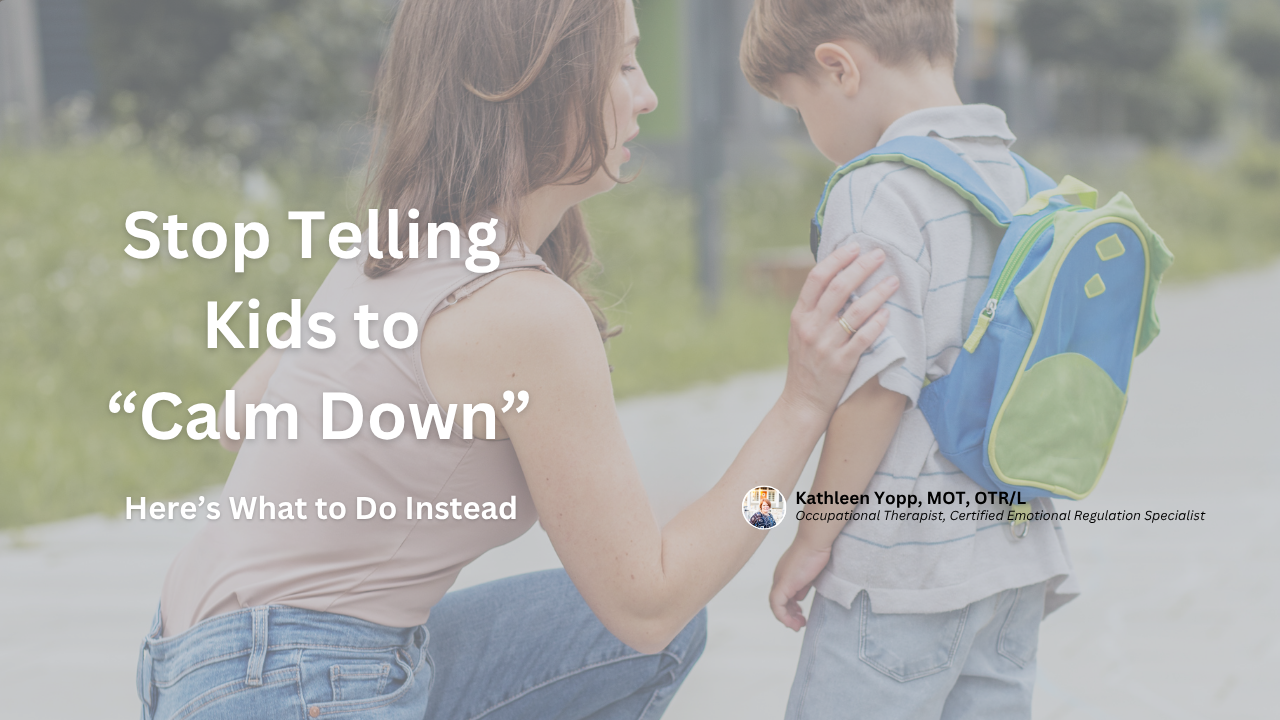
“Calm down.”
It is a phrase that many of us—parents, therapists, and educators—have said.
Especially when a child is overwhelmed, upset, overstimulated, anxious, or completely melting down.
I know I have.
In fact, I used to say it to my own children.
Not angrily.
I would get close and say in a soft, loving voice:
“I need you to be calm.”
But eventually, I realized something that completely changed the way I thought about emotional regulation.
My child didn't necessarily know HOW to be calm in that moment.
I was telling her what I wanted her to do.
But I needed to help her body get there.
So instead of continuing to tell her to calm down, I started showing her what calm could feel like.
I got down on her level.
I slowed down my own voice.
I softened my body.
I offered gentle pressure and reassurance.
I stayed with her.
In other words, I stopped expecting self-regulation in a moment when she needed co-regulation.
And that realization led me to a question I now encourage parents, therapists, and educators to ask:
When We Tell a Child to “Calm Down,” Do They Actually Know How?
Think about what we're asking.
“Calm down.”
Do they know how?
Do they have the capacity to access that skill in this particular moment?
Have we taught them strategies they can use?
Can they recognize that they're becoming dysregulated early enough to use those strategies?
Or do they still need support from a regulated adult to help their body get there?
And here's another question we don't ask nearly enough:
Does their body even know what “calm” feels like?
Regulation isn't a switch a child can simply flip.
It's a skill—and a capacity—we have to help them develop.
What Is Co-Regulation?
Before many children can consistently regulate themselves, they need experiences of regulation with another person.
That's co-regulation.
A supportive adult may change their own voice, body language, pace, proximity, demands, or environment in response to what the child needs.
Sometimes that means talking less.
Sometimes it means getting down on the child's level.
Sometimes it means reassurance or connection.
Sometimes it means movement or sensory input.
And sometimes it means giving the child more space.
Co-regulation isn't about forcing a child into a calm state.
It's about helping create the conditions in which their nervous system has a better opportunity to regulate.
Over time, these repeated experiences can help children develop greater awareness of their own bodies and build regulation skills they can increasingly use themselves.
Before We Teach “Calm,” We Have to Teach “Notice”
One of the most important regulation skills we can help children develop is the ability to notice what is happening inside their bodies.
What does your body feel like when you're calm?
And what begins to change when you're worried, frustrated, excited, overwhelmed, or angry?
You can start with simple questions:
What happens to your breathing when you're nervous?
What does your belly feel like when you're worried?
Does your heart feel different when you're excited?
What happens to your muscles when you're angry?
Do you feel hot or cold?
Do you want to move more—or get away?
These questions begin developing interoception.
What Is Interoception?
Interoception refers to our awareness and interpretation of signals coming from inside our bodies.
Those signals can include things such as hunger, thirst, temperature, heart rate, breathing, muscle tension, bladder and bowel sensations, fatigue, and other internal sensations.
Interoception can also play an important role in emotional regulation.
Why?
Because before a child can independently choose a regulation strategy, it helps if they can recognize:
“Something is changing.”
A child who only recognizes dysregulation once they are completely overwhelmed has much less opportunity to use a strategy early.
That's why I don't want to teach children only what anger, anxiety, or overwhelm looks like.
I want them to learn what regulation feels like, too.
Help Children Notice Their Regulated State
We spend a lot of time talking to children about their bodies when something is wrong.
Try noticing the other moments, too.
When your child is relaxed beside you, you might say:
“Your body looks really comfortable right now. I wonder what it feels like inside.”
After swinging, jumping, or another activity they enjoy:
“Let's check in with your body. Does your heart feel fast or slow? How does your breathing feel?”
During a quiet moment:
“What do you notice in your shoulders? What about your hands? Your belly?”
We're not testing them.
We're helping them become curious about their bodies.
That distinction matters.
What Should You Do When a Child Is Already Dysregulated?
This is where we need to change the question.
Instead of immediately asking:
“How do I get this child to calm down?”
Try asking:
“What is this child's nervous system communicating right now?”
And:
“What support might their body need?”
The answer won't be the same for every child.
One child may benefit from movement.
Another may seek deep pressure.
Another may need less noise, less language, or less visual stimulation.
Another may need a trusted adult nearby.
Another may need demands temporarily reduced.
And yes, breathing can be one useful regulation tool—but it isn't the right tool for every child or every moment.
That's why regulation can't simply be a collection of coping strategies.
We have to understand the child in front of us.
The Goal Is More Than Getting a Child to Stop a Behavior
This is one of the biggest shifts I want parents, educators, and therapists to make.
When we focus exclusively on stopping the outward behavior, we can miss what the behavior may be communicating.
Instead of only teaching:
“When you're angry, take a deep breath.”
I want children to gradually develop the awareness to recognize:
“Something is changing in my body.”
“I know what that might mean.”
“And I know something I can try.”
That's a very different skill.
We're not simply teaching a child how to appear calm.
We're helping them build the capacity for regulation.
A Resource to Help Children Start Noticing Their Bodies
I created a Kids Breathing Toolkit for ages 5–12 to help children explore breathing and body awareness in a playful way.
It includes:
-
A body map for exploring internal sensations
-
Six animal breathing activities
-
A personalized “My Breathing Plan”
-
A practice tracker
-
Before-and-after body check-ins
The goal isn't perfect breathing.
The goal is helping children become curious about their own bodies.
Download the Kids Breathing Toolkit
For Therapists
If you work with children who struggle with emotional regulation, sensory processing, meltdowns, anxiety, or accessing coping strategies, breathing is only one small part of the clinical picture.
Inside my Certified Emotional Regulation Specialist (CERS) training, I teach a broader framework for understanding what may be driving dysregulation and how to choose interventions based on the individual child's presentation.
Learn More About the CERS Certification
For Parents
If you're a parent who wants to better understand what's happening underneath your child's big emotions and learn practical ways to support regulation, you can also explore my Calm the Chaos: Emotional Resilience Training for Parents.
Learn More About Calm the Chaos
The next time you're about to say “calm down,” consider asking yourself a different question:
“What does this child need from me right now to help their body move toward regulation?”
That small shift can change the entire interaction.
Because before we expect children to regulate themselves, sometimes we first have to show them what regulation feels like.
Explore the complete collection of courses, guides, downloads, parent resources, professional tools, and Regulation-First™ resources.
Get Regulation-First™ Tools & Strategies in Your Inbox
Join therapists, parents, and educators learning how to look beyond behavior and better understand what's happening underneath it.
You'll receive practical strategies, educational resources, new tools, and updates to help you support regulation, sensory processing, feeding, toileting, interoception, and more.
Don't worry, your information will not be shared.
We hate SPAM. We will never sell your information, for any reason.
