Why Feeding Therapy Stalls: 5 Factors Therapists Miss
Sep 20, 2026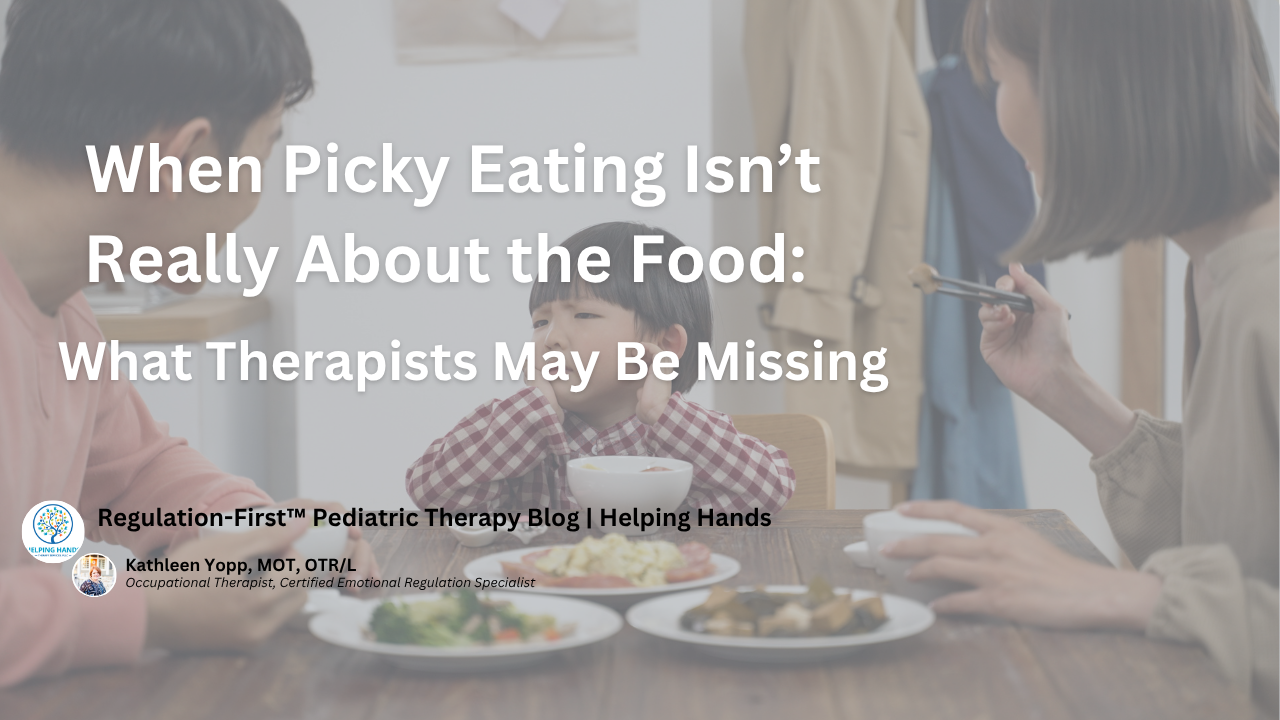
When Picky Eating Isn’t Really About the Food: What Therapists May Be Missing
You’ve tried food chaining.
You’ve introduced preferred foods alongside new foods.
You’ve played with the food, smelled the food, touched the food, and worked your way through a carefully designed exposure hierarchy.
And yet...
The child still refuses.
They gag when something unfamiliar appears on the plate. They become upset before the meal even begins. Their list of accepted foods keeps getting smaller. Or they participate beautifully during feeding therapy—but none of it carries over at home.
When this happens, it’s easy to assume you simply haven’t found the right feeding strategy yet.
But after decades of working with children with sensory, feeding, interoceptive, and regulation challenges, I think we need to ask a different question:
What if the food isn't actually the first problem we need to address?
For some children, feeding difficulties are about much more than taste and texture.
The nervous system, interoception, gastrointestinal comfort, previous experiences with food, environmental demands, sensory processing, motor skills, and emotional state can all influence a child's ability to comfortably participate in eating.
And if we only focus on getting closer to the food, we may miss what is making eating difficult in the first place.
1. The Child May Not Feel Safe Enough to Explore
We often talk about food exploration as if willingness is primarily a behavioral decision.
Touch it.
Smell it.
Kiss it.
Lick it.
Take a tiny bite.
These strategies can be useful for some children. But there is an important step that comes before exploration:
Does this child's nervous system feel safe enough to be curious?
Think about your own relationship with food.
Imagine someone places something unfamiliar in front of you. It smells strange. You don't know what is in it. The texture makes you uncomfortable.
Then everyone starts watching you.
"Just try it."
"You don't have to eat it."
"Just touch it."
Suddenly, eating isn't simply eating anymore.
There's an expectation attached to it.
For a child who is already highly sensitive to sensory input, uncertainty, internal body sensations, or demands, that expectation can be enough to shift the experience from curiosity toward protection.
And a protective nervous system isn't particularly interested in exploring broccoli.
It's interested in getting away from broccoli.
That's an important distinction.
2. Interoception May Be Affecting the Entire Feeding Experience
One of the most overlooked pieces of feeding therapy is interoception.
Interoception is our ability to notice and interpret signals coming from inside the body.
Those signals include sensations related to:
-
hunger
-
fullness
-
thirst
-
nausea
-
stomach discomfort
-
needing to use the bathroom
-
heart rate
-
breathing
-
temperature
-
emotional states
We frequently ask children:
"Are you hungry?"
But what if they genuinely don't know?
One child may barely notice hunger until they are extremely hungry and dysregulated.
Another may interpret normal stomach sensations as discomfort.
Another may struggle to differentiate hunger from nausea, anxiety, constipation, or fullness.
And another may have learned that eating is sometimes followed by uncomfortable sensations.
Suddenly, feeding isn't just about what is on the plate.
It's also about what is happening inside the child's body.
If we aren't assessing interoception, we may be missing an important piece of the feeding puzzle.
3. Nervous-System State Can Change Readiness for Eating
Feeding doesn't happen separately from the rest of the body.
When a child is stressed, overwhelmed, highly activated, or shut down, their readiness to participate in eating may change.
You may see this as:
-
little interest in food
-
difficulty sitting at the table
-
increased gagging or sensitivity
-
rapid eating
-
difficulty recognizing fullness
-
refusal
-
avoidance
-
leaving the table
-
emotional escalation around meals
This doesn't mean that every feeding difficulty is caused by nervous-system dysregulation.
It means state matters.
Instead of immediately asking:
"How can I get them to try this food?"
we may need to first ask:
"What state is this child in right now—and is their system ready for this demand?"
Sometimes regulation needs to come before exploration.
That is one of the foundational principles behind a Regulation-First™ approach.
4. Even Gentle Feeding Strategies Can Become Demands
This one can be uncomfortable for therapists because many of us were trained to use gradual exposure.
And gradual exposure itself isn't necessarily the problem.
The issue is what the child experiences.
Consider the difference between:
"You have to eat three bites."
and
"You don't have to eat it. Just lick it."
To us, the second request feels dramatically less demanding.
To the child's nervous system?
It may still feel like:
Someone wants me to do something with this food that I don't feel ready to do.
We can unintentionally increase pressure even when we believe we're providing choice.
This is especially important for children who are highly sensitive to demands, have experienced stressful feeding interactions, or have learned to anticipate pressure whenever unfamiliar food appears.
Sometimes we need to stop asking:
"How small can I make the demand?"
and start asking:
"How can I increase safety, autonomy, and curiosity?"
That's a very different therapeutic goal.
5. The Feeding Problem May Not Be Primarily Sensory
When a child has a limited diet, sensory processing is often one of the first areas therapists consider.
And sensory differences absolutely can contribute to feeding challenges.
But "sensory" shouldn't become our default explanation for every selective eater.
A child's feeding difficulties may involve a combination of factors, including:
-
oral-motor skills
-
sensory processing
-
interoception
-
gastrointestinal discomfort
-
constipation
-
appetite
-
previous choking, gagging, vomiting, or painful eating experiences
-
fear associated with food
-
executive functioning
-
environmental demands
-
nervous-system state
-
learned associations
-
mealtime dynamics
-
medical or physiological factors
This is why assessment matters so much.
If a child avoids eating because eating has historically caused discomfort, increasing food exposure doesn't address the underlying issue.
If a child doesn't reliably recognize hunger, a reward chart doesn't teach them what hunger feels like.
If unfamiliar foods trigger an intense protective response, simply increasing the number of exposures may not create the sense of safety we're hoping for.
Different drivers require different interventions.
And sometimes multiple drivers are operating at the same time.
A Regulation-First™ Reframe for Feeding Therapy
This is the shift I want more feeding therapists to consider.
Instead of beginning with:
"How do I get this child to interact with this food?"
Begin with:
"What is making eating difficult for this child right now?"
That question changes everything.
Now we're investigating instead of convincing.
We're looking at the whole child instead of only the food.
We're asking:
What is the child's body telling us?
What sensory experiences are difficult?
What internal sensations can they recognize?
Are there signs that warrant medical or GI referral?
What happens before the child refuses?
What does the mealtime environment feel like?
How much pressure has become associated with eating?
Does the child feel in control of what happens to their body?
What happens when expectations around food disappear?
And perhaps most importantly:
What does this child's feeding behavior communicate?
Because refusal is information.
Avoidance is information.
Gagging is information.
Leaving the table is information.
Eating only a small group of predictable foods is information.
Our job isn't simply to eliminate those behaviors.
Our job is to understand what they may be telling us.
Before Your Next Feeding Session, Try This
When you're working with a child whose feeding progress has stalled, resist the urge to immediately add another food strategy.
Instead, look at the feeding challenge through several different lenses:
BODY:
Could discomfort, constipation, hunger/fullness awareness, or another physiological factor be contributing?
SENSORY:
What does the child experience through taste, smell, texture, temperature, sight, sound, and touch?
INTEROCEPTION:
Can the child recognize and interpret the internal sensations associated with eating?
REGULATION:
What state is the child's nervous system in before and during the meal?
EXPERIENCE:
What has the child learned to expect when unfamiliar food appears?
ENVIRONMENT:
What demands, distractions, routines, relationships, or expectations surround eating?
You may discover that the question isn't:
"Which food should I introduce next?"
It may be:
"What needs to change so this child's system is more available for eating, exploring, and learning?"
Feeding Therapy Needs More Than a Collection of Strategies
There is no single technique that works for every child with feeding difficulties.
That's exactly why I created the Regulation-First™ Feeding Certification for therapists and professionals.
Rather than giving you another list of tricks to get children to try foods, this training is designed to help you develop the clinical reasoning to look more deeply at why feeding may be difficult for the individual child in front of you.
We explore feeding through a Regulation-First™ lens—including sensory processing, interoception, nervous-system regulation, environmental demands, feeding experiences, and other factors that may be influencing participation.
Because when you understand more about what is driving the feeding challenge, you can make more intentional decisions about what to address next.
If you're a therapist working with picky eating, food refusal, highly restricted diets, or children who seem "stuck" despite traditional strategies, I'd love to have you join me.
Become a Regulation-First™ Feeding Provider
Learn to look beyond the food—and understand the child behind the feeding challenge.
LEARN MORE ABOUT THE REGULATION-FIRST™ FEEDING CERTIFICATION
Explore the complete collection of courses, guides, downloads, parent resources, professional tools, and Regulation-First™ resources.
Get Regulation-First™ Tools & Strategies in Your Inbox
Join therapists, parents, and educators learning how to look beyond behavior and better understand what's happening underneath it.
You'll receive practical strategies, educational resources, new tools, and updates to help you support regulation, sensory processing, feeding, toileting, interoception, and more.
Don't worry, your information will not be shared.
We hate SPAM. We will never sell your information, for any reason.
